About Hampi

Architecture
Temples, buildings, inscriptions & irrigation works

Virupaksha Temple
Rising more than 50 meters above the street, the whitewashed tower gleams in the brilliant sunshine. The Vijayanagara - period gopuras, derives from Tamil prototypes of the 11th & 12th centuries. This is an authentic Vijayanagara period structure made by Krishnadevaraya on the occasion of his coronation in 1510.
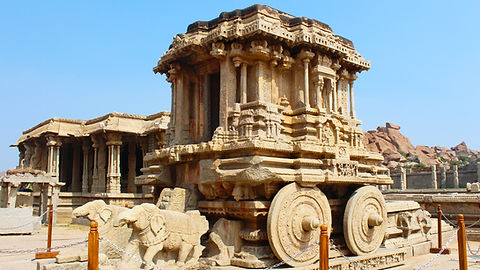
Vitthala Temple - Chariot
The chariot stands in front of the temple with pairs of wheels on the sides and a small Garuda shrine with exquisite cutout colonettes above. The chariot was built in 1554. The profusion of decaying mandapas, colonnades, mathas, kitchens, wells and chattras in the vicinity testify to an active urban life.

Bhojana Shala
The Bhojana Shala consists of green chloritic schist slabs carved with circular thali-like dishes on either side of a water channel, as if for an outdoor picnic spot for courtiers.
The 'Underground' Temple
So-called because it was once partly buried, but it is now fully exposed by excavation. Set well below ground level, the temple's somewhat austere interior is usually partly flooded with water from surrounding fields, compelling visitors to wade through its gloomy halls.


Stepped Tank
The Stepped Tank varies from other Hampi constructions in that it is made up of nicely polished blocks of black schist stones. The fundamental use of this tank is unknown, however, it was utilized by the royals for religious events. These tanks were utilized for ceremonies of concretion, purification, and rituals. The water tanks, which originate from the Ganges, are regarded sacred and are even used to immerse Ganesha idols. Typically, these ponds are built near temples and utilized for washing and purifying activities before prayers.
Narsimha Monolith
This man-lion form of Vishnu is reclining in a yogic pose under a multi-headed naga capped by a monster mask in this huge monument, which is 6.7 meters tall. The deity has a horrifying countenance with bulging eyeballs and teeth, although he and his spouse, Lakshmi, are depicted in an emotionless attitude. One has it that two brothers called 1528 were commissioned by Krishnadevaraya, according to an engraved stone put up in front of the gateway.


Lotus Mahal
One of the best-preserved monuments in the royal center is the Lotus Mahal. Despite its quirky name, this structure was most likely used as a council chamber. The pavilion is designed in the shape of a square mandala, with symmetrical projections on all four sides. The pavilion's high molded stone foundation, the double-curved eave that shelters the arches, and the cluster of nine pyramidal towers that rise above are all inspired by temple architecture. The lobed arches, on the other hand, are encircled by plaster ornamentation, while the inner domes and vaults are sultanate in design. These varied roots result in a wonderful mixture of characteristics that exemplifies the Vijayanagara's brilliance.
Akka Thangiyara
Two massive rocks stand near together, separated by a short gap. There is a legend about them, according to which two sisters once visited Hampi. They were exhausted after touring all of the ruins and sat down to rest. The younger sister advised her older sister that she should have stayed at home rather than go so far as to visit the ruins. They turned into stones as soon as she uttered this. This incident could not possibly have occurred. It must have circulated in order for people to be aware of these wonderful ruins.


Elephant Stables
The stables are made up of a long row of eleven chambers, each of which can hold two elephants. Alternating domes and twelve-sided vaults rise symmetrically on each side of a central elevated chamber that may have been designed for drummers and other musicians.
Krishna Temple
The Krishna temple complex, the core of Krishnapura, another section of the holy center, is located around 500 meters south of Hampi. It, too, has a vast bazaar street that extends to the east, but it is placed at a lower elevation than the temple, whose colonnades are engulfed by sugarcane and banana plantations. A rectangular tank is picturesquely positioned behind a rocky overhang a few meters to the north of the roadway, encircled by additional colonnades and with a tiny pavilion standing in the midst of the water
